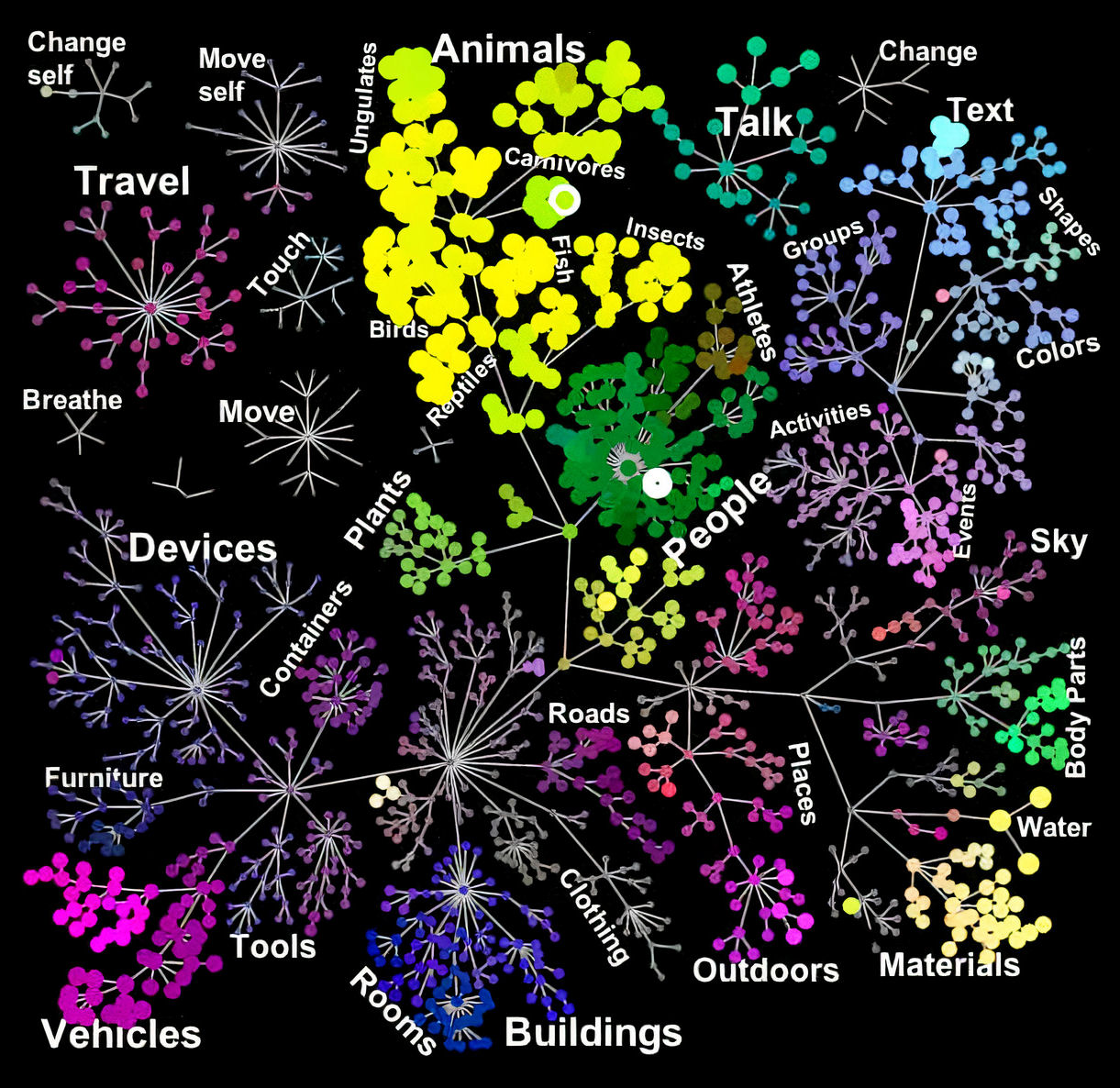
Visual exposure to the semantic concept network is a rare and extraordinary hallucinatory phenomenon in which the individual perceives what appears to be the entirety of their stored knowledge rendered as an immense, interconnected web of geometric forms. Each node in this network is an innately comprehensible visual representation of a specific concept, memory, or piece of information, and the connections between nodes reveal the associative relationships that link these concepts together. The overall impression is of witnessing one's own mind'sknowledge graph — the complete map of everything one has ever learned, experienced, or understood — laid out in visual space.
The experience is often triggered by a specific stimulus — a word, a thought, an observation — which manifests as a geometric form at the center of the visual field and then begins to branch outward along associative pathways. If someone speaks the word "ocean," the observer might see a visual representation of the ocean concept spawn immediate connections to water, salt, marine life, waves, beaches, ships — each of which spawns its own connections in turn. "Marine life" branches to fish, coral, whales, evolution; "ships" branches to trade, exploration, history, navigation. This branching continues outward with explosive speed until the visual field is filled with an impossibly dense, fractal-like network of interconnected concepts.
At lower intensities, this process is intermittent and can be partially controlled — the observer can watch a concept branch outward, follow a particular thread, and then "reset" as the visualization fades. At higher intensities, however, the branching becomes self-sustaining and all-encompassing. The sheer volume of simultaneously represented concepts overwhelms sensory processing capacity, producing a state of totalcognitive and perceptual overload. The individual may be temporarily disconnected from their external environment as the concept network fills their entire visual field, and the experience may trigger brief episodes of ego dissolution as the boundary between "the observer" and "the contents of the mind" breaks down.
The semantic concept network shares characteristics with the inner mechanics of consciousness effect but differs in its content emphasis. While the inner mechanics effect focuses on the structure of consciousness itself — how the mind works — the semantic concept network focuses on thecontent of consciousness — what the mind knows. Both involve the perception of innately meaningful geometry, but the concept network feels more like accessing a database while the inner mechanics feel more like reading the operating system.
This effect is most commonly induced by high doses of psychedelics with strong visual and cognitive components — particularlyLSD,psilocybin,DMT, andmescaline — and typically occurs during peak intensity experiences where geometric hallucinations have reached their highest levels of complexity. It is rare, dose-dependent, and often accompanied by ego death, thought acceleration, and profound states of awe or cognitive overwhelm.