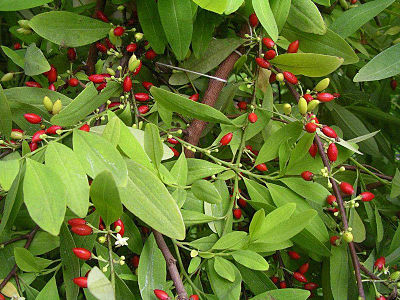
Group of plant varieties cultivated for coca and cocaine production
Coca refers to any of the four cultivated plants in the family Erythroxylaceae, native to western South America. It is known worldwide for its psychoactive alkaloid, cocaine. The leaves contain cocaine, which acts as a mild stimulant when chewed or consumed as tea; this traditional use involves slower absorption than purified cocaine, and there is no evidence of addiction or withdrawal symptoms from such natural consumption.
The coca plant is a shrub-like bush with curved branches, oval leaves marked by distinct curved lines, and small yellowish-white flowers that develop into red berries. Genomic analysis indicates coca was domesticated two or three separate times from the wild species Erythroxylum gracilipes by different South American groups during the Holocene. Chewing coca leaves dates back at least 8,000 years in South America, as evidenced by coca leaves and calcite found in house floors in Peru's Nanchoc Valley, suggesting early communal use alongside the rise of farming. Coca use was widespread under Inca rule. The Incas deeply integrated it into their society for labor, religion, and trade, valuing it so highly that they colonized new lands for its cultivation. Spanish colonizers later attempted to suppress its use, but ultimately relied on it to sustain enslaved laborers. Traditionally, across Andean cultures, coca leaves have been used for medicinal, nutritional, religious, and social purposes—serving as a stimulant, remedy for ailments, spiritual tool, and source of sustenance, primarily through chewing and tea.
Coca thrives in hot, humid environments and can be harvested multiple times a year from carefully tended plots. It is grown as a cash crop in the Argentine Northwest, Bolivia, the Alto Rio Negro Indigenous Territory in Brazil, Colombia, Venezuela, Ecuador, and Peru, including in areas where its cultivation is unlawful. There are some reports of cultivation in southern Mexico using seeds imported from South America, as an alternative to smuggling the processed drug cocaine. The plant plays a fundamental role in many traditional Amazonian and Andean cultures, as well as among indigenous groups in the Sierra Nevada de Santa Marta of northern Colombia.
Coca leaves are used commercially and industrially in teas, foods, cosmetics, and beverages. Their legal commercial use has growing political and market support in countries like Bolivia and Peru, despite restrictions in others like Colombia. The international prohibition of the coca leaf, established by the 1961 United Nations Single Convention—which did not distinguish it from cocaine despite traditional Andean uses—has been widely contested. Bolivia and Peru have led ongoing efforts to reevaluate its status, including a scheduled 2025 WHO review based on cultural and scientific grounds. Outside South America, coca leaf is generally illegal or heavily restricted, often treated similarly to cocaine. Limited exceptions exist for scientific or medical use, and for specific authorized imports such as the decocainized leaf extract used for Coca-Cola flavoring in the United States.
The cocaine alkaloid content in dry Erythroxylum coca var. coca leaves ranges from 0.23% to 0.96%. Coca-Cola used coca leaf extract in its products from 1885 until about 1903, when it switched to using a decocainized leaf extract. Extracting cocaine from coca requires several solvents and a chemical process known as an acid–base extraction, which can efficiently isolate the alkaloids from the plant material.