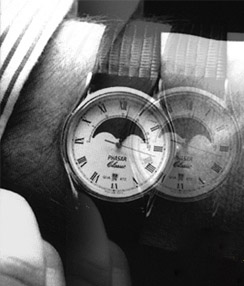
The visual experience of seeing a single object as two separate, overlapping images, similar to crossing one's eyes, ranging from subtle ghosting to complete inability to perceive fine detail.
Description
Double vision, clinically known as diplopia, is defined as the experience of seeing a single object as two separate overlapping or adjacent images. The effect is similar to what occurs when one deliberately crosses their eyes, except that it arises involuntarily as a result of substance-induced disruption to the coordination of the eye muscles or the brain's ability to fuse the slightly different images received from each eye into a single coherent picture. The two images may appear side by side, stacked vertically, or offset diagonally, and they may be of equal or differing clarity.
The intensity of double vision manifests across a clear spectrum. At the lowest level, the doubling is subtle and mostly ignorable, presenting as a slight ghosting or shadowing around objects that, although obviously present, is not intense enough to prevent the person from reading text, recognizing faces, or navigating their environment. At moderate levels, the doubling becomes pronounced enough to make reading and perceiving fine details extremely difficult, though large-scale features of the environment remain perceivable with both eyes open. At the most intense level, double vision becomes so severe that the person can no longer accurately perceive either small or large-scale visual details, necessitating that they close one eye at all times in order to function.
The mechanism behind substance-induced double vision typically involves disruption of the precise coordination between the six extraocular muscles that control each eye's position and movement. Normally, the brain coordinates these muscles with remarkable precision to ensure that both eyes point at exactly the same spot, allowing binocular fusion. Many substances, particularly CNS depressants and dissociatives, interfere with this coordination by depressing neural activity in the brainstem nuclei that control eye movement, or by disrupting the cerebellum's fine-tuning of motor output.
Double vision is most commonly induced under the influence of moderate dosages of depressant and dissociative compounds such as alcohol, quetiapine, ketamine, and DXM. Alcohol is perhaps the most widely recognized cause, with diplopia being a hallmark of significant intoxication. However, the effect can also occur less consistently under a wide range of other substance classes, including hallucinogens, stimulants, anticholinergics, SSRIs, opioids, GABAergics, and cannabinoids. Any substance that affects muscle coordination or neural processing in the visual system has the potential to produce this effect.
Double vision is often accompanied by other coinciding effects such as visual acuity suppression, pattern recognition suppression, motor control loss, and dizziness. Together, these effects can significantly impair the person's ability to interact with their environment, particularly for tasks requiring visual precision such as reading, using a phone, driving, or navigating unfamiliar spaces. The combination of double vision with motor impairment creates a compounded disability that is greater than either effect alone.
While double vision is generally transient and resolves as the substance is metabolized, it can be practically managed during the experience by closing one eye, which eliminates the binocular component and restores a single, if monocular, image. This simple technique can make the difference between being functionally incapacitated and being able to perform basic tasks. However, monocular vision sacrifices depth perception, so caution should still be exercised when moving around.